ANTERO DE ALDA Photography Recent Works
|
A cancer on America
Last Saturday, November 13th, was released the Burmese dissident and Nobel Peace Prize (1991), San Suu Kyi. Speaking of freedom, I recall in which Kyi pointed to her head and said something like this: «In here I am free. In here they cannot strike me...»
The episode reminded me of Allende. Perhaps because also in the head of the President of Chile toppled in 1973, there was a certain disease, a 'cancer' that America would not wanted to understand. Let's approach the current Chilean affair, since next December 10th marks the celebration of four years pasted, since the death of the dictator Pinochet.
Passing through one university at Rome, the Mexican poet Carlos Fuentes said: «El diablo va a tener un mal día, porque le van a quitar la presidencia del infierno.» (The Devil will have a bad day, because they’ll steal him the presidency of hell)
If Americans have regretted the dictatorship years in Chile, it is legitimate to expect that the Communists may also regret the repression on the Republic of Myanmar. How far is it, all in all, heaven from hell?
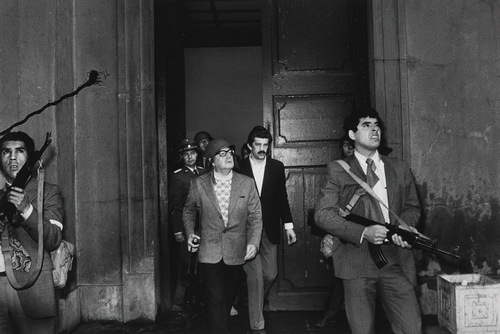
Allende’s resistance to the air strike on the La Moneda Palace, Santiago. photo by ORLANDO LAGOS/The New York Times, September 11th, 1973. The photographer's identity was not revealed until one year after his death in February 2007. World Press Photo Award
«Poor Pinochet must be imprisoned.» According to El Negro (Carlos Jorquera, journalist, member of GAP, and a survivor of La Moneda), those were the exact words of Salvador Allende, pronounced what would be about seven-thirty in the morning of September 11th, 1973, shortly after learning that the Navy had been infected by traitors who were preparing to coup the power in Valparaíso. The Chilean president took his Army Chief of Staff for innocent, but in the body of this insidious chained America, heiress of McCarthyism, the only innocent (the only true naives) could only be the communist intruders.
El diablo Pinochet: some dictatorship chapters
«I will not retreat a single step! Let them know that I’ll only abandon La Moneda when I fulfil the term of office given to me by the people. Only by riddling my body with bullets shall I be prevented from fulfilling the popular program.» ALLENDE, National Stadium of Santiago, December 2nd, 1971.
1. The son of the bitch The lonely resistance of Allende began with a long chase from the CIA long before 73, but the greatest threat to the leader of the Popular Unity government took place under President Nixon: «—Son of a bitch! —Son of a bitch!» cried out the USA President in his office, in the White House, beating furiously with his right fist into the palm of his left hand. According to an investigation conducted by Chilean filmmaker Patricio Henriquez ('El Ultimo Combate de Salvador Allende' – Salvador Allende’s final battle – Télé-Québec/France 3, 1998), half of the U.S.A. and much of Europe — the Vatican, the Christian democracies of Italy and Germany, the royal families of Belgium and the Netherlands ... — Were committed and only rested when La Moneda started to burn.
2. September September was the month of the coup and it was the preferred month for the executions. It was in September that the Dirección de Inteligencia Nacional (National Intelligence Direction), the so called DINA, loved to kill. Prats (General Carlos Prats, a former commander in chief of the army) was murdered on the 30th, in Buenos Aires, September, 1974. Letelier (Orlando Letelier, a diplomat and political opponent of the regime) was also the victim of a device manufactured by Michael Townley, allegedly remotely operated by dissident Cubans living in Miami, on the 21st, in Washington, September, 1976. It was essentially in September that the bodies of communists appeared floating in the rivers of Chile.
3. In the rivers of Chile... The mornings of the days that followed the September 11th were for counting the dead. For 15 years, hundreds of widows would go to the banks of rivers Ñuble and Mapocho, or would travel to the port of Talcahuano, hoping to recover the bodies of their missing husbands. Many were recovered without head, with hands tied behind their backs, burned by cigarette butts, riddled with bullets and with crushed testicles. Others never appeared, because they were tossed into the waters of army helicopters, after being cut open by the abdomen and eviscerated, so that they would not float.
4. The Anarchist Cookbook, trinitrate and Chanel bottles Michael Townley was an American adventurer, a neo-Nazi bourgeois who pledged his services to General Contreras (then director of DINA). He and his girlfriend used to gather groups of fascists on the streets of Santiago to protest against the Allende’s government, accusing it of pursuing the rich and favouring the poor. With the help of 'The Anarchist Cookbook' (by William Powell, 1971), Townley became an expert in the preparation of Molotov cocktails and other plastic explosives with TNT with sugar, to which he called «dirty bombs». For what he called «discrete deaths», he wore Chanel perfume bottles with asphyxiating gas.
5. The disco, the sex-shop and Valoria The sailboats "Lebu", "Maipo" and "La Esmeralda" (the imposing Chilean Navy vessel-school, also known as White Lady), as well as the infamous Colónia Dignidad (Villa Baviera, founded in 1961 by a group of former German-Nazis) were used by the secret police torture practices. According to reports from survivors, who testified for a documentary filmed by British director Christopher Olgiati ('The Assassin', BBC-Paladim, 1992), in one of those numerous torture centres there was a room which they called «disco», because they put music to muffle the screams of the victims. Besides the «disco» there was another room, which they called «sex-shop», where they held painful sexual abuses with the help of a huge hound, named Valoria.
«Mis palabras no tienen amargura sino decepción. Que sean ellas el castigo moral para los que han traicionado el juramento que hicieron. (My words contain no bitterness, but disappointment. Let them morally punish those who have betrayed the oath which they have taken)» ALLENDE, in the historical speech of September 11th, 1973.
«Andaban a zancadas por las tremendas cordilleras, por las Américas encrespadas, buscando patatas, butifarras, frijolitos, tabaco negro, oro, maíz, huevos fritos, con aquel apetito voraz que nunca más se ha visto en el mundo... Todo se lo tragaban, con religiones, pirámides, tribus, idolatrías iguales a las que ellos traían en sus grandes bolsas... Por donde pasaban quedaba arrasada la tierra... Se llevaron el oro y nos dejaron el oro... Se lo llevaron todo y nos dejaron todo... Nos dejaron las palabras.» "They walked with tremendous strides through the huge mountain ranges, by the curled Americas, looking for potatoes, sausages, beans, black tobacco, gold, corn, fried eggs, with that voracious appetite that has never been seen again in the world ... Swallowed it all, with different religions, pyramids, tribes, idolatries the same as they were bringing in their large bags... Wherever they passed, the earth was scorched... They took the gold and left us the gold... They took everything and left us everything... They’ve left us the words." PABLO NERUDA, 'Las palabras', in Memorias, 1974.
Inspired on the giant vulture that flies over and terrorizes the Andes mountain range, the tragic Operation Condor was fatal to the malign communist flesh, not only in Chile but also in Argentina, Bolivia, Brazil, Paraguay and Uruguay. For Nixon, Kissinger, Haig ... and ultimately for all that melodramatic and hypochondriac America, it was a kind of healing that made them suffer more than the disease itself.
____ Lo que las palabras no dicen (That which words don’t tell) When on the daybreak of December 11th, 2006, in the Hall of Honor of the Military School of Libertador Bernardo O'Higgins, in Santiago, the body of Pinochet was watched over, Francisco Cuadrado Prats (grandson of Carlos Prats) approached the deceased and spit in his face, over the glass dome. They asked him why he had done such a thing and if he was afraid of retaliation. He replied: «Él asesinó mis abuelos!» (He murdered my grandparents!) And afterwards told the newspaper: «Sólo fue un gesto y los gestos dicen lo que las palabras no pueden expresar.» (It was a single gesture and gestures say what words cannot express)
|